
we deliver a bold new paradigm.
-
联系方式
联系方式信息
- 地址: 韩国首尔特别市江西区麻谷东路55,8楼(07802)
- 营业执照号码: 109-86-37282
- CEO: Choongseong Han
- 电话: +82-2-2088-8886
- 传真: +82-2-2088-8884
- 电子邮箱: support@nexel.co.kr
Human iPSC-derived Brain Organoid (Cerebral Organoid) Development
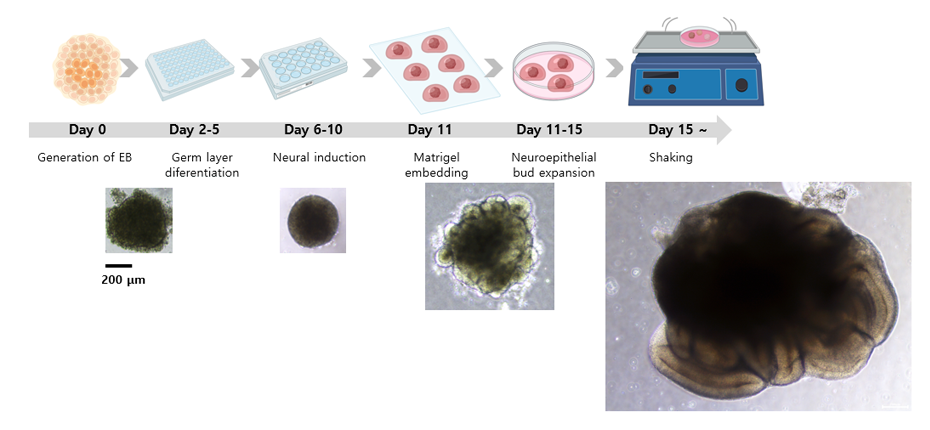
Brain organoids are generated through the stages of EB formation, germ layer differentiation, neural induction, neuroepithelial expansion, and maturation.
They proliferate for up to two months, growing in size to over 5 mm.
Brain organoids are composed mainly of neurons, neural stem cells, and immune cells.
They recapitulate diverse brain regions, including the cerebral cortex, forebrain, choroid plexus, and hippocampus.
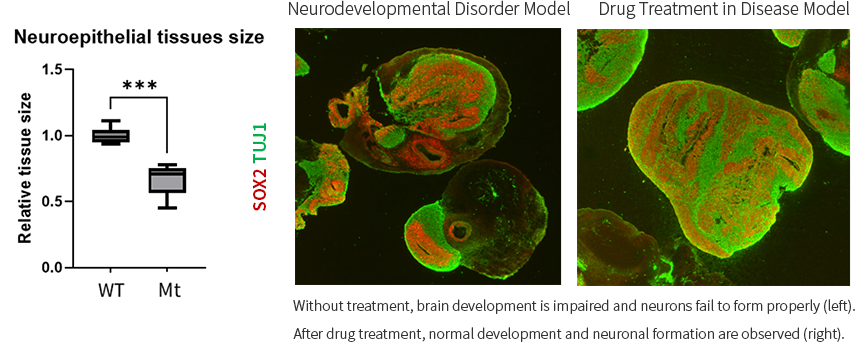
3D brain organoids can be used to model neurodevelopmental disorders, observable through their size and structural characteristics.
Based on this approach, we are conducting research on disease modeling and drug testing.
Human iPSC-derived Brain Organoid (Cerebral Organoid) Development
- Brain organoids are generated through the stages of EB formation, germ layer differentiation, neural induction, neuroepithelial expansion, and maturation.
- They proliferate for up to two months, growing in size to over 5 mm.
- Brain organoids are composed mainly of neurons, neural stem cells, and immune cells.
- They recapitulate diverse brain regions, including the cerebral cortex, forebrain, choroid plexus, and hippocampus.
- 3D brain organoids can be used to model neurodevelopmental disorders, observable through their size and structural characteristics.
- Based on this approach, we are conducting research on disease modeling and drug testing.